
About the freedom course
Freedom is a seven-week journey through the Exodus story. The class traces how God meets people who feel stuck, burdened by regret, confused about identity, weighed down by shame, or uncertain whether their past can be redeemed.
Click Link to Jump to Content
Lesson One
Lesson Two
Lesson Three
Lesson Four
Lesson Five
Lesson Six
Click Link to Jump to Content
Lesson One
Lesson Two
Lesson Three
Lesson Four
Lesson Five
Lesson Six
Lesson 1 — When Life Does Not Turn Out as Planned
The aim of this lesson is to help us see that who we are and where we are today are connected to our family history. No matter our present circumstances, God is at work within our story and desires to move us forward in His purposes.
Read exodus 1:1-7
The book of Exodus begins with a list of Abraham’s descendants who came to Egypt. These verses tell us that Israel’s bondage in Egypt has a backstory. Long before Abraham had children of his own, God told him that his descendants would live in a land that was not theirs and would be enslaved for four hundred years (See Genesis 15:13–16).
A key figure in the opening verses of the Exodus story is Abraham’s great-grandson, Joseph (Exodus 1:6). Joseph’s life explains how Israel came to be in Egypt in the first place. His story shows how family systems shape individual lives and how patterns can move through generations.
Repeating Patterns Across Generations
Abraham — Fear and Survival Shape Decisions (Genesis 12:10–20; 20:1–13).
Pattern established: fear-driven choices during uncertainty.
Isaac — Favoritism Within the Home (Genesis 25:28).
Pattern reinforced: parental favoritism creates rivalry.
Jacob — Deception and Family Conflict (Genesis 27:1–35).
Pattern continues: deception used to secure blessing.
Jacob’s Household — Divided Family System (Genesis 29:30–31; 30:1–24).
Pattern expands: competition and insecurity within the family system.
A key figure in the opening verses of the Exodus story is Abraham’s great-grandson, Joseph (Exodus 1:6). Joseph’s life explains how Israel came to be in Egypt in the first place. His story shows how family systems shape individual lives and how patterns can move through generations.
Repeating Patterns Across Generations
Abraham — Fear and Survival Shape Decisions (Genesis 12:10–20; 20:1–13).
Pattern established: fear-driven choices during uncertainty.
Isaac — Favoritism Within the Home (Genesis 25:28).
Pattern reinforced: parental favoritism creates rivalry.
Jacob — Deception and Family Conflict (Genesis 27:1–35).
Pattern continues: deception used to secure blessing.
Jacob’s Household — Divided Family System (Genesis 29:30–31; 30:1–24).
Pattern expands: competition and insecurity within the family system.
How to Read Joseph’s Family System
Joseph is born into a multi-generational, blended family system shaped by favoritism, rivalry, loss, and competition. These patterns do not begin with him, but they profoundly shape his life.
Key Notes For Joseph's Family System
Large blended family
Multiple mothers within one household
Clear birth-order differences among siblings
Unexpected death of mother
(See Genesis 35:16–26)
Joseph’s Life Within This System
Joseph — Favored Son (Genesis 37:3–4).
Pattern repeated: favoritism passed to the next generation.
Joseph — Betrayed by Brothers (Genesis 37:12–28).
Pattern escalates: unresolved rivalry leads to betrayal.
Joseph — Displacement and Loss (Genesis 37:36).
Individual consequence: family conflict reshapes his life circumstances.
Joseph — God at Work in Egypt (Genesis 39:2–3, 20–23).
New movement: God works within the broken system, not outside it.
Joseph — Family Relocation to Egypt (Genesis 46:1–7).
Generational outcome: family patterns result in long-term placement in Egypt.
Key takeaway: God worked faithfully within Joseph’s complex family system to move His purposes forward (see Genesis 37:24; 41:14; 45:5-8; 50:20).
Key Notes For Joseph's Family System
Large blended family
Multiple mothers within one household
Clear birth-order differences among siblings
Unexpected death of mother
(See Genesis 35:16–26)
Joseph’s Life Within This System
Joseph — Favored Son (Genesis 37:3–4).
Pattern repeated: favoritism passed to the next generation.
Joseph — Betrayed by Brothers (Genesis 37:12–28).
Pattern escalates: unresolved rivalry leads to betrayal.
Joseph — Displacement and Loss (Genesis 37:36).
Individual consequence: family conflict reshapes his life circumstances.
Joseph — God at Work in Egypt (Genesis 39:2–3, 20–23).
New movement: God works within the broken system, not outside it.
Joseph — Family Relocation to Egypt (Genesis 46:1–7).
Generational outcome: family patterns result in long-term placement in Egypt.
Key takeaway: God worked faithfully within Joseph’s complex family system to move His purposes forward (see Genesis 37:24; 41:14; 45:5-8; 50:20).
Genogram Exercise
A genogram is a graphical representation of family relationships showing the quality and proximity of relationships and patterns across generations.
Questions to Ask
Step 1 — Who Is in Your Family System?
Who are the key people in your family across two or three generations?
Include parents, grandparents, siblings, and children.
(If you are unsure about someone, it is fine to leave it blank.)
Step 2 — Living Situations
Who raised you?
Were there deaths, divorces, separations, or remarriages?
If so, who did you live with?
Step 3 — Children and Birth Order
Who else lived in your home?
How many children were in each family?
What was the birth order?
Are there any siblings who died young or were not raised in the home?
Step 4 — Basic Relationship Closeness
Which relationships felt close?
Which felt distant?
Who in your family provided stability or support?
Step 5 — Patterns You Notice
Do you notice repeated patterns such as:
favoritism
distance between siblings
Strong bonds between certain people
Questions to Ask
Step 1 — Who Is in Your Family System?
Who are the key people in your family across two or three generations?
Include parents, grandparents, siblings, and children.
(If you are unsure about someone, it is fine to leave it blank.)
Step 2 — Living Situations
Who raised you?
Were there deaths, divorces, separations, or remarriages?
If so, who did you live with?
Step 3 — Children and Birth Order
Who else lived in your home?
How many children were in each family?
What was the birth order?
Are there any siblings who died young or were not raised in the home?
Step 4 — Basic Relationship Closeness
Which relationships felt close?
Which felt distant?
Who in your family provided stability or support?
Step 5 — Patterns You Notice
Do you notice repeated patterns such as:
favoritism
distance between siblings
Strong bonds between certain people
Genogram resources
Many approaches to doing a genogram exist. The purpose of this exercise is to provide awareness to your family history and highlight relationships that play a part in who you are and where you are today.
Feel free to search the internet for "genogram examples." Here are a few resources that may be helpful.
Feel free to search the internet for "genogram examples." Here are a few resources that may be helpful.
Lesson 2 — When Life Takes Different Turns
Our first lesson focussed on family systems. The aim of this lesson is to help us see how certain events, both good and bad, shape the direction of our lives. Even when those events feel unexpected or painful, God is at work using them to prepare us for what comes next.
read exodus 2:1-22
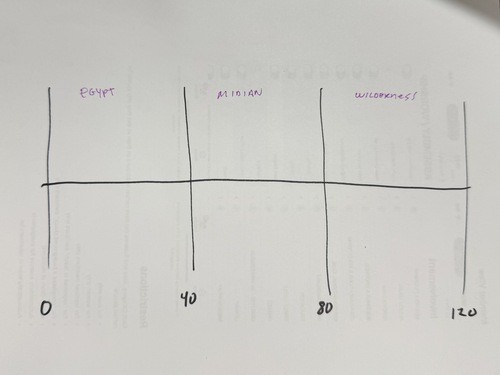
The Bible gives us three clear seasons of Moses’ life: Moses was 40 when he fled, 80 when God called him, and 120 when he died. While we will not likely live as long as Moses, we see that God often does His deepest work later than people expect. Moses’ life, from the beginning, was shaped by loss of family, questions about identity, consequences for violent actions, and long seasons of waiting. Yet it was through those very experiences that God formed him for the work he would eventually be called to do.
The life of moses in 3 seasons
Season 1: Birth to 40 years
Moses is born under Pharaoh’s decree and rescued from death (Exodus 2:1–10).
He is raised in Pharaoh’s household and educated in Egyptian power and privilege (Acts 7:22).
At about 40 years old, Moses kills an Egyptian and flees Egypt (Acts 7:23–29).
Season 2: 40 to 80 years
Moses lives in Midian as a shepherd (Exodus 2:15–22).
He marries, raises a family, and lives a quiet, hidden life.
At about 80 years old, God calls Moses at the burning bush (Exodus 3:1–10; Acts 7:30).
Season 3: 80 to 120 years
Moses returns to Egypt and confronts Pharaoh (Exodus 4–12).
He leads Israel through the Red Sea (Exodus 14).
He leads Israel through the wilderness, receives the Law, and guides the nation for forty years.
Moses dies at 120 years old on the edge of the Promised Land (Deuteronomy 34:7).
Moses is born under Pharaoh’s decree and rescued from death (Exodus 2:1–10).
He is raised in Pharaoh’s household and educated in Egyptian power and privilege (Acts 7:22).
At about 40 years old, Moses kills an Egyptian and flees Egypt (Acts 7:23–29).
Season 2: 40 to 80 years
Moses lives in Midian as a shepherd (Exodus 2:15–22).
He marries, raises a family, and lives a quiet, hidden life.
At about 80 years old, God calls Moses at the burning bush (Exodus 3:1–10; Acts 7:30).
Season 3: 80 to 120 years
Moses returns to Egypt and confronts Pharaoh (Exodus 4–12).
He leads Israel through the Red Sea (Exodus 14).
He leads Israel through the wilderness, receives the Law, and guides the nation for forty years.
Moses dies at 120 years old on the edge of the Promised Land (Deuteronomy 34:7).
Exercise 1: Seeing Life In Seasons
This rough overview of Moses’ life allows us to step back and look at his story as a whole rather than as a collection of isolated moments. Looking at life this way helps us see movement, change, and growth over time.
Consider the following questions:
•Why might it be beneficial to look at a life in seasons instead of only in moments?
•How does seeing Moses’ life in three seasons change the way you see his story?
•How does the fact that Moses’ greatest work came late in life shape the way you think about your own story?
Consider the following questions:
•Why might it be beneficial to look at a life in seasons instead of only in moments?
•How does seeing Moses’ life in three seasons change the way you see his story?
•How does the fact that Moses’ greatest work came late in life shape the way you think about your own story?
The Life of Moses in 10 Major Events
1.Moses is born under threat and rescued
Exodus 2:1–10
Age: birth to infancy
Pharaoh orders Hebrew baby boys killed. Moses is preserved and lives.
2.Moses is nursed by his mother and adopted into Pharaoh’s household
Exodus 2:7–10; Acts 7:21–22
Age: infancy to young adulthood (roughly 2 to 40)
Moses begins life in a Hebrew home and is then raised as the son of Pharaoh’s daughter with Egyptian education and status.
3.Moses kills an Egyptian and flees Egypt
Exodus 2:11–15; Acts 7:23
Age: about 40
After witnessing injustice, Moses kills an Egyptian this single violent moment ends his life in Egypt and forces exile.
4.Moses finds refuge in Midian and meets a Priest
Exodus 2:16–20
Age: early 40s
Moses is treated kindly by a forienger with seven daughters.
5.Moses marries Zipporah and becomes a father
Exodus 2:21-22; 18:3-4
Age: early 40s
Moses, for the first time, belongs to a family of his own.
6.Moses lives as a shepherd in Midian
Exodus 3:1
Age: roughly 40–80
Moses spends decades in ordinary work, far from power and status.
7.God calls Moses at the burning bush
Exodus 3:1–12; Acts 7:30
Age: about 80
God calls Moses when he believes his life is mostly behind him.
8.Moses returns to Egypt as God’s messenger
Exodus 4–7
Age: early 80s
Moses returns to Egypt to face his past and speak for God.
9.Moses leads Israel out of Egypt and through the sea
Exodus 12–14
Age: early 80s
Moses becomes the public leader of God’s people.
10. Moses leads Israel through the wilderness and dies at 120
Numbers–Deuteronomy; Deuteronomy 34:1–7
Age: 80–120
Moses leads for forty years and dies on the edge of the Promised Land.
Exodus 2:1–10
Age: birth to infancy
Pharaoh orders Hebrew baby boys killed. Moses is preserved and lives.
2.Moses is nursed by his mother and adopted into Pharaoh’s household
Exodus 2:7–10; Acts 7:21–22
Age: infancy to young adulthood (roughly 2 to 40)
Moses begins life in a Hebrew home and is then raised as the son of Pharaoh’s daughter with Egyptian education and status.
3.Moses kills an Egyptian and flees Egypt
Exodus 2:11–15; Acts 7:23
Age: about 40
After witnessing injustice, Moses kills an Egyptian this single violent moment ends his life in Egypt and forces exile.
4.Moses finds refuge in Midian and meets a Priest
Exodus 2:16–20
Age: early 40s
Moses is treated kindly by a forienger with seven daughters.
5.Moses marries Zipporah and becomes a father
Exodus 2:21-22; 18:3-4
Age: early 40s
Moses, for the first time, belongs to a family of his own.
6.Moses lives as a shepherd in Midian
Exodus 3:1
Age: roughly 40–80
Moses spends decades in ordinary work, far from power and status.
7.God calls Moses at the burning bush
Exodus 3:1–12; Acts 7:30
Age: about 80
God calls Moses when he believes his life is mostly behind him.
8.Moses returns to Egypt as God’s messenger
Exodus 4–7
Age: early 80s
Moses returns to Egypt to face his past and speak for God.
9.Moses leads Israel out of Egypt and through the sea
Exodus 12–14
Age: early 80s
Moses becomes the public leader of God’s people.
10. Moses leads Israel through the wilderness and dies at 120
Numbers–Deuteronomy; Deuteronomy 34:1–7
Age: 80–120
Moses leads for forty years and dies on the edge of the Promised Land.
Exercise 2: Seeing Life In Movements
A timeline is not just a list of events. It shows how moments change direction. Let’s practice with Moses. Choose one event from Moses’ life and reflect on it using these questions:
•Which event from Moses’ life stands out to you most?
•How did that moment change Moses’ direction?
•How do you think that moment prepared him for what came later?
•Which event from Moses’ life stands out to you most?
•How did that moment change Moses’ direction?
•How do you think that moment prepared him for what came later?
Exercise 3: Dividing My Life Into Chapters
If you divided your life into three chapters, how would you describe the first chapter?
How would you describe the chapter you are in right now?
What would you want the next chapter of your life to be about?
How would you describe the chapter you are in right now?
What would you want the next chapter of your life to be about?

Exercise 4: Defining Moments Lightning Round
Just as Moses’ life unfolded through a series of defining moments, each of us has a story shaped by turning points. We are going to sketch those moments, not to relive them, but to understand how we got here.
Set a timer for five minutes. Answer the following questions. You do not have to use complete sentences or go in detail. Simply write down the first thing that comes to mind. If nothing comes to mind, skip the question and go to the next.
1.What is one of your earliest memories?
2.What is a time when life did not go as planned?
3.What is a moment when you had to grow up or take responsibility?
4.What is a time when you experienced loss, disappointment, or failure?
5.What is a season when something new began?
6.What is a relationship or event that changed how you see yourself?
7.What is a moment when you felt stuck or uncertain?
8.What is a moment when you felt supported or helped?
9.What is a recent event that feels important to where you are now?
10.What is one moment you believe God used to help you or others, even if it was difficult?
Set a timer for five minutes. Answer the following questions. You do not have to use complete sentences or go in detail. Simply write down the first thing that comes to mind. If nothing comes to mind, skip the question and go to the next.
1.What is one of your earliest memories?
2.What is a time when life did not go as planned?
3.What is a moment when you had to grow up or take responsibility?
4.What is a time when you experienced loss, disappointment, or failure?
5.What is a season when something new began?
6.What is a relationship or event that changed how you see yourself?
7.What is a moment when you felt stuck or uncertain?
8.What is a moment when you felt supported or helped?
9.What is a recent event that feels important to where you are now?
10.What is one moment you believe God used to help you or others, even if it was difficult?
Life Timeline
A timeline is a simple way of mapping the important events of a person’s life from beginning to the present. In therapy, it helps people move from seeing their life as a collection of problems to seeing it as a story with chapters and turning points.
Over the next week, take time to think about the events in your life that have shaped who you are today. Use the questions below to begin mapping your story.
•Which events do you think had the biggest impact on you?
•What are some high points in your life so far?
•What are some low points in your life so far?
Place these events in chronological order on the timeline. If an event was a high point, place it above the horizontal line. If it was a low point, place it below the line.
Over the next week, take time to think about the events in your life that have shaped who you are today. Use the questions below to begin mapping your story.
•Which events do you think had the biggest impact on you?
•What are some high points in your life so far?
•What are some low points in your life so far?
Place these events in chronological order on the timeline. If an event was a high point, place it above the horizontal line. If it was a low point, place it below the line.
Lesson 3 — When the Time Comes for God to Use Us
God often calls people who feel unqualified and unready. The aim of this lesson is to help us focus on our strengths instead of our weaknesses, and to recognize that God often uses what is already present in our lives when He calls us to step forward.
Read Exodus 3:1-10
This section begins with Moses’ “new normal.” He is working an ordinary job for his father-in-law. Nothing seems extraordinary about his situation. Life, as far as we know, is steady. Then, in a moment, God interrupts his life with a holy calling.
God reveals to Moses that He has heard the groaning of His people in Egypt, remembered His covenant with their forefathers, looked upon their oppression, and is going to bring them out of Egypt. The catch is that Moses is the person God is commissioning to lead the rescue mission.
In our previous lesson, we looked at key events in Moses’ life. To put this event into perspective, it had been nearly forty years since Moses fled Egypt. He fled because he killed an Egyptian and Pharaoh sought his life. Now, God calls Moses to return. As you can imagine, Moses is apprehensive and uncomfortable with the idea.
God reveals to Moses that He has heard the groaning of His people in Egypt, remembered His covenant with their forefathers, looked upon their oppression, and is going to bring them out of Egypt. The catch is that Moses is the person God is commissioning to lead the rescue mission.
In our previous lesson, we looked at key events in Moses’ life. To put this event into perspective, it had been nearly forty years since Moses fled Egypt. He fled because he killed an Egyptian and Pharaoh sought his life. Now, God calls Moses to return. As you can imagine, Moses is apprehensive and uncomfortable with the idea.
The Objections of Moses
“Who am I that I should go to Pharaoh?” (Exodus 3:11–12)
Moses’ first objection is that he lacks the standing required to go before a man of great power.
“What do I say to the people? Who do I tell them sent me?” (Exodus 3:13–22)
Moses’ second objection is that he lacks the necessary information to fulfill the request.
“What if they do not believe what I say?” (Exodus 4:1–9)
Moses’ third objection is that he lacks credibility and fears the people will not accept him as a leader.
“I am slow of speech and slow of tongue.” (Exodus 4:10–12)
Moses’ fourth objection is that he lacks the ability to communicate God’s message.
Moses’ first objection is that he lacks the standing required to go before a man of great power.
“What do I say to the people? Who do I tell them sent me?” (Exodus 3:13–22)
Moses’ second objection is that he lacks the necessary information to fulfill the request.
“What if they do not believe what I say?” (Exodus 4:1–9)
Moses’ third objection is that he lacks credibility and fears the people will not accept him as a leader.
“I am slow of speech and slow of tongue.” (Exodus 4:10–12)
Moses’ fourth objection is that he lacks the ability to communicate God’s message.
Exercise 1: How God RespondS
Throughout Exodus 3–4, Moses focuses on what he believes he lacks. For every objection Moses raises, God responds by directing him away from self-focus and toward God’s provision. Throughout the burning bush incident, God points to what Moses already possesses and shows how it can be used to accomplish what He is calling Moses to do.
Fill in the blanks based on the text.
Moses’ source of power…
God responds by reminding Moses:
“I will certainly be _________ you.” (Exodus 3:12)
Moses’ lack of knowledge…
God responds by revealing:
“I _____ WHO I _____.” (Exodus 3:14–15)
(Also: “The LORD God of your fathers… has sent me to you.”)
Moses’ fear of how people would respond…
God responds by providing:
Signs to ____________ Moses’ message. (Exodus 4:2–9)
(The staff becomes a serpent, the hand becomes leprous then healed, water becomes blood.)
Moses’ concern over his speech…
God responds by promising:
“I will be with your mouth and _________ you what you shall say.” (Exodus 4:11–12)
Fast-forward to after Israel has crossed the sea. Moses’ perspective has changed. He acknowledges that God Himself is the source of his strength. In Exodus 15:2, he declares, “The LORD is my strength and my song, and He has become my salvation.”
Fill in the blanks based on the text.
Moses’ source of power…
God responds by reminding Moses:
“I will certainly be _________ you.” (Exodus 3:12)
Moses’ lack of knowledge…
God responds by revealing:
“I _____ WHO I _____.” (Exodus 3:14–15)
(Also: “The LORD God of your fathers… has sent me to you.”)
Moses’ fear of how people would respond…
God responds by providing:
Signs to ____________ Moses’ message. (Exodus 4:2–9)
(The staff becomes a serpent, the hand becomes leprous then healed, water becomes blood.)
Moses’ concern over his speech…
God responds by promising:
“I will be with your mouth and _________ you what you shall say.” (Exodus 4:11–12)
Fast-forward to after Israel has crossed the sea. Moses’ perspective has changed. He acknowledges that God Himself is the source of his strength. In Exodus 15:2, he declares, “The LORD is my strength and my song, and He has become my salvation.”
Exercise 2: Connecting the Dots (Discussion)
Who was Moses’ source of strength according to Moses?
Who was Moses’ source of strength according to God?
Is it possible to ever “know enough” about a specific topic or situation before acting?
Are we ever fully prepared for the journey of life?
Who was Moses’ source of strength according to God?
Is it possible to ever “know enough” about a specific topic or situation before acting?
Are we ever fully prepared for the journey of life?
From Objections to Strengths
It is easy to get stuck. Sometimes we get stuck because we are looking back at our past. Other times we get stuck because we are worried about what lies ahead. Like Moses, God calls us to focus on the present. He invites us to acknowledge how our story, with all its ups and downs, can be redeemed and used for His glory.
Thus far in this course, we have explored our family history and our life timeline. Some parts of our story were shaped by circumstances beyond our control. Other parts were shaped by choices we made and their consequences. In both cases, one truth remains: we cannot change the past. While we cannot change what has already happened, we can begin to change the meaning of our past and how it shapes the way we move forward.
“We cannot change the past, but we can change the meaning of our past.”
Thus far in this course, we have explored our family history and our life timeline. Some parts of our story were shaped by circumstances beyond our control. Other parts were shaped by choices we made and their consequences. In both cases, one truth remains: we cannot change the past. While we cannot change what has already happened, we can begin to change the meaning of our past and how it shapes the way we move forward.
“We cannot change the past, but we can change the meaning of our past.”
Exercise 3 - Strengths Exploration
“In the right situation, our weaknesses become our strengths” - David Rendall
What are two or three strengths you see in your life right now? (These may include experiences, skills, personality traits, or lessons learned.)
Which part of your story has been difficult but has also shaped you in a meaningful way?
How might something you once viewed as a weakness actually serve as a strength in the right situation?
Where do you see an opportunity, right now, to use one of these strengths?
How does Moses’ journey help you rethink what God might be able to use in your own life?
Which part of your story has been difficult but has also shaped you in a meaningful way?
How might something you once viewed as a weakness actually serve as a strength in the right situation?
Where do you see an opportunity, right now, to use one of these strengths?
How does Moses’ journey help you rethink what God might be able to use in your own life?
Exercise 4 - Personality Strengths
In this exercise, you will take the free personality assessment at 16personalities.com. This tool helps identify your natural preferences, strengths, and typical ways of responding to the world. Understanding your personality can give insight into how you think, make decisions, lead, communicate, and handle stress.
Lesson 4 — When God Calls Us to Trust Him (and others)
Our story is rarely practiced alone. The aim of this lesson is to help us recognize the importance of relationships and become more aware of the support systems around us right now.
Read exodus 12:1-13
What takes place in this section marks a major turning point in Israel’s story. For the first time, God’s instructions are not directed only at a leader, but at households. Every family is given the same responsibility and the same opportunity to respond.
Consider a few observations from the reading.
First, no Israelite is excluded from deliverance.
Salvation is obtained by obeying God’s commands.
Second, no one is called to walk alone.
Protection is found by participating in community with people of faith.
Lastly, no one is able to remain passive.
Obedience requires a deliberate response from every household.
Consider a few observations from the reading.
First, no Israelite is excluded from deliverance.
Salvation is obtained by obeying God’s commands.
Second, no one is called to walk alone.
Protection is found by participating in community with people of faith.
Lastly, no one is able to remain passive.
Obedience requires a deliberate response from every household.
Exercise 1: A Community Effort
Go back through Exodus 12:1–13 and note at least five words or phrases that show how God designed this moment to be carried out as a group rather than individually.
Note: As you read, look for language that highlights households, families, shared responsibility, and collective participation.
1.
2.
3.
4.
5.
Note: As you read, look for language that highlights households, families, shared responsibility, and collective participation.
1.
2.
3.
4.
5.
Read Exodus 12:21–28
This section shifts the focus from instruction to outcome. The people act, but the text repeatedly emphasizes what God is doing (or will do) in and through their obedience.
Consider a few observations from the reading.
First, God provides clear direction. Moses passes on God’s commands so the people know exactly how to respond.
Second, God honors faithful obedience. When the people do as they are told, God blesses their actions.
Lastly, God brings promised deliverance. The LORD passes through Egypt, spares the households marked by the blood, and carries out the promise He made.
Consider a few observations from the reading.
First, God provides clear direction. Moses passes on God’s commands so the people know exactly how to respond.
Second, God honors faithful obedience. When the people do as they are told, God blesses their actions.
Lastly, God brings promised deliverance. The LORD passes through Egypt, spares the households marked by the blood, and carries out the promise He made.
Exercise 2: Noticing God at Work
Go back through Exodus 12:21–28 and pay close attention to what God is doing or promising to do in this moment.
Note: As you read, list five actions that are attributed to God in the text. Use simple words or short phrases drawn directly from the passage.
1.
2.
3.
4.
5.
Note: As you read, list five actions that are attributed to God in the text. Use simple words or short phrases drawn directly from the passage.
1.
2.
3.
4.
5.
The Importance of Support Systems
Before leaving Egypt, Israel did not simply trust God in isolation. They trusted God while surrounded by others who were walking through the same moment.
Major transitions in life are rarely navigated alone. Even when we have burned bridges, lost close connections, or moved into new environments, the presence or absence of support plays a significant role in how we cope with change.
Major transitions in life are rarely navigated alone. Even when we have burned bridges, lost close connections, or moved into new environments, the presence or absence of support plays a significant role in how we cope with change.
Exercise 3: Identifying Support Systems
Social capital is a sociological concept that refers to the invisible resources that develop through our relationships and social interactions. This exercise is designed to increase awareness of the support systems currently present in our lives.
Who are the people you interact with most during an average week?
What groups, settings, or communities are you currently connected to (work, school, family, church, social spaces)?
Which of these connections provide practical support such as information, help, or opportunities?
Which relationships tend to open doors or create opportunities for you?
Which relationships do you tend to avoid or distance yourself from during difficult seasons?
Who are the people you interact with most during an average week?
What groups, settings, or communities are you currently connected to (work, school, family, church, social spaces)?
Which of these connections provide practical support such as information, help, or opportunities?
Which relationships tend to open doors or create opportunities for you?
Which relationships do you tend to avoid or distance yourself from during difficult seasons?
Exercise 4: Draw An Ecomap
A genogram is used to understand a person within their family environment across generations. An ecomap is used to understand a person within their broader social and community environment.
Four categories:
1) Top Left - Bio/Psycho
2) Top Right - Environmental
3) Bottom Right - Social
4) Bottom Left - Spiritual
Center:
Your name
Twelve subcategories:
Environmental (work, live, learn)
Social (family, friends, activities)
Spiritual (community, practices, milestones)
Bio/Psycho (Physical health, mental health, medication/treatment)
Four categories:
1) Top Left - Bio/Psycho
2) Top Right - Environmental
3) Bottom Right - Social
4) Bottom Left - Spiritual
Center:
Your name
Twelve subcategories:
Environmental (work, live, learn)
Social (family, friends, activities)
Spiritual (community, practices, milestones)
Bio/Psycho (Physical health, mental health, medication/treatment)

Lesson 5 - When Faith is Put to the Test
To say you will do something is one thing. Actually going through with doing it is another. The aim of this lesson is to examine how people respond when progress is interrupted by fear and uncertainty. Just as we start moving in the right direction, obstacles often appear that test our resolve and expose what we truly believe.
Read Exodus 14:1-9
In the previous chapter, Egypt experienced its final devastated plague — the death of the firstborn. The firstborn in every Egyptian household died. The cry that rose from the land was unlike anything before it. Pharaoh told Israel to leave. The people left quickly.
Instead of taking a route that would put them up against the Philistines (13:17-22), God routed them to a place that made it seem as if they were trapped. It was here that God told Moses to tell the children of Israel that He’s got this and that there is a greater purpose — the Egyptians will know that Jehovah is God (cp. 7:5; 14:4, 25).
Verses 5–9 shift the scene back to Egypt. Pharaoh’s grief hardens into regret. He begins to question his decision. “What have we done, that we have let Israel go from serving us?”
Pharaoh gathers his chariots and chooses six hundred of his best. What God said would happen, is starting to happen. Deliverance has happened. Pursuit has begun. The stage is set for faith to be tested.
Instead of taking a route that would put them up against the Philistines (13:17-22), God routed them to a place that made it seem as if they were trapped. It was here that God told Moses to tell the children of Israel that He’s got this and that there is a greater purpose — the Egyptians will know that Jehovah is God (cp. 7:5; 14:4, 25).
Verses 5–9 shift the scene back to Egypt. Pharaoh’s grief hardens into regret. He begins to question his decision. “What have we done, that we have let Israel go from serving us?”
Pharaoh gathers his chariots and chooses six hundred of his best. What God said would happen, is starting to happen. Deliverance has happened. Pursuit has begun. The stage is set for faith to be tested.
Read Exodus 14:10-18
The moment the Israelites see the Egyptians marching after them, the tone shifts. The text says they were “very afraid.” The same people who had just walked out of Egypt under God’s protection now panic at the sight of opposition.
The Test and How Israel Initially Responded
They were very afraid (14:10). Fear became their dominant emotion. The reality of danger overwhelmed the memory of deliverance.
They cried out to the LORD (14:10). Their first instinct was to call for help, though this cry is quickly followed by complaint.
They blamed Moses (14:11). “Because there were no graves in Egypt, have you taken us away to die in the wilderness?” Anxiety turns into accusation.
They romanticized the past (14:12). “It would have been better for us to serve the Egyptians than that we should die in the wilderness.” Under pressure, slavery begins to look safer than freedom.
They cried out to the LORD (14:10). Their first instinct was to call for help, though this cry is quickly followed by complaint.
They blamed Moses (14:11). “Because there were no graves in Egypt, have you taken us away to die in the wilderness?” Anxiety turns into accusation.
They romanticized the past (14:12). “It would have been better for us to serve the Egyptians than that we should die in the wilderness.” Under pressure, slavery begins to look safer than freedom.
Exercise 1 - When Fear Starts Talking
When the Israelites saw the Egyptian army approaching, fear shaped the way they interpreted the situation. This exercise will help us examine how beliefs form under pressure. By looking at this event from their perspective and distinguishing between what is true and what felt true, learn how fear clouds our judgment and influences our responses in moments of uncertainty.
Step 1: What Were They Thinking?
Read Exodus 14:10–12. In one simple sentence, what do you think the people believed in that moment?
Step 2: Was That Thought Accurate?
Had God already delivered them from Egypt?
(See Exodus 12:31-33, 41-42, 13:3)
Had they seen His power before this moment?
(See Exodus 7–12; 12:29-30, 36; 13:21-22)
Did they actually know how the situation would end?
(See Exodus 14:13-14)
(See Exodus 12:31-33, 41-42, 13:3)
Had they seen His power before this moment?
(See Exodus 7–12; 12:29-30, 36; 13:21-22)
Did they actually know how the situation would end?
(See Exodus 14:13-14)
Exercise 2 - The ABCDE Model at the Red Sea
The ABCDE model (often associated with Albert Ellis and REBT) looks like this:
A – Activating Event
B – Belief
C – Consequence
D – Dispute
E – Effective New Belief
A – Activating Event
B – Belief
C – Consequence
D – Dispute
E – Effective New Belief
A = Activating Event
Read Exodus 14:10.
What happened that triggered fear?
Write the event in one clear sentence:
What happened that triggered fear?
Write the event in one clear sentence:
B = Belief
Read Exodus 14:11–12.
What belief did the people form about the situation?
In one simple sentence, what did they tell themselves?
What belief did the people form about the situation?
In one simple sentence, what did they tell themselves?
C = Consequence
Based on verses 10–12:
How did that belief affect them emotionally?
How did it affect their behavior?
How did that belief affect them emotionally?
How did it affect their behavior?
D = Dispute
Read Exodus 14:13–14.
How does Moses challenge their fear-based belief?
What truth does he introduce that contradicts their assumption?
How does Moses challenge their fear-based belief?
What truth does he introduce that contradicts their assumption?
E = Effective New Belief
Read Exodus 14:15–18.
If the people accepted Moses’ words, what new belief would guide them?
Write a healthier, more grounded belief statement:
Example format:
“Even though ____________, we can trust that ____________.”
If the people accepted Moses’ words, what new belief would guide them?
Write a healthier, more grounded belief statement:
Example format:
“Even though ____________, we can trust that ____________.”
Lesson 6 - On the path to freedom
Israel is no longer enslaved. They have seen plagues. They have walked through the sea. Pharaoh and his army are in the past. They are free but not totally settled. The aim of this lesson is to explore what life looked like for Israel after the dramatic moment of deliverance and to consider how freedom does not instantly produce stability.
Read Exodus 16:1-8
Imagine a day in the life of Israel. They wake up in a tent. The Red Sea is behind them. Egypt is no longer visible. There are no taskmasters shouting commands. Yet there is also no farmland. There is no barn or supermarket to buy grain. There is no long term plan. There is only desert.
This new found freedom feels different than they imagined. Within a matter of weeks, the tone has shifted. Instead of celebrating, the whole congregation complains.
This new found freedom feels different than they imagined. Within a matter of weeks, the tone has shifted. Instead of celebrating, the whole congregation complains.
Romanticizing the Past
Under stress, people often engage in mental filtering. When people move through major transitions, especially after leaving something difficult, the mind often edits the story. Under stress, we tend to remember what felt predictable and minimize what was painful.
Israel does this in Exodus 16. They remember the pots of meat. They forget the whips. They remember bread. They forget bondage. They remember routine. They forget slavery. They remember comfort. They forget cruelty. They remember predictability. They forget oppression.
Sometimes what holds us back isn’t the actual past, but the way we remember it.
Israel believed:
Egypt = predictable food
Wilderness = uncertainty
But the deeper truth was:
Egypt = slavery
Wilderness = formation
They misremembered what they left.
Israel does this in Exodus 16. They remember the pots of meat. They forget the whips. They remember bread. They forget bondage. They remember routine. They forget slavery. They remember comfort. They forget cruelty. They remember predictability. They forget oppression.
Sometimes what holds us back isn’t the actual past, but the way we remember it.
Israel believed:
Egypt = predictable food
Wilderness = uncertainty
But the deeper truth was:
Egypt = slavery
Wilderness = formation
They misremembered what they left.
Exercise 1 - Short Term Relief vs Long Term Freedom
Read Exodus 16:2–3 again.
If Israel returned to Egypt, what immediate need would feel satisfied?
What would they lose?
List two short term benefits of going back to Egypt:
1.
2.
List two long term consequences of going back:
1.
2.
If Israel returned to Egypt, what immediate need would feel satisfied?
What would they lose?
List two short term benefits of going back to Egypt:
1.
2.
List two long term consequences of going back:
1.
2.
Read Exodus 16:4, 16–20
The wilderness was not designed to starve Israel. It was designed to retrain them. In Egypt, their survival depended on Pharaoh. Now, in the wilderness, survival depends on God.
While Israel sees only a change in location, the deeper freedom God is shaping requires a change in mindset. Leaving Egypt was physical. Learning to trust was internal.
So when Israel complains, God responds with provision. He gives them bread in the morning and meat in the evening. He does not shame them for their hunger. He feeds them.
While Israel sees only a change in location, the deeper freedom God is shaping requires a change in mindset. Leaving Egypt was physical. Learning to trust was internal.
So when Israel complains, God responds with provision. He gives them bread in the morning and meat in the evening. He does not shame them for their hunger. He feeds them.
The Manna Principle
The Manna Principle teaches that lasting freedom comes from learning to rely on what is provided for today.
At the very beginning of the journey, God shows Israel that real freedom is found in basic routines.
Every morning they must:
•Walk outside.
•Gather manna.
•Take only what they need.
•Trust there will be more tomorrow.
This may sound simple, but God wants us to trust Him one day at a time.
At the very beginning of the journey, God shows Israel that real freedom is found in basic routines.
Every morning they must:
•Walk outside.
•Gather manna.
•Take only what they need.
•Trust there will be more tomorrow.
This may sound simple, but God wants us to trust Him one day at a time.
Breaking The Cycle
What we read in Exodus 16 is not an isolated complaint. This pattern of “looking back” is a reoccurring theme.
Exodus 14:11–12 — At the Red Sea
Exodus 15:24 — At Marah (Bitter Water)
Exodus 16:2–3 — Hunger in the Wilderness
Exodus 17:2–3 — No Water at Rephidim
Exodus 32:1 — The Golden Calf
Numbers 11:4–6 — The Bounty of Egypt
Numbers 14:3–4 — The Full Regression Moment
Every time basic needs or stability feel threatened, Egypt starts looking attractive. People do not want to return because slavery was good. They want to return because uncertainty feels worse.
Exodus 14:11–12 — At the Red Sea
Exodus 15:24 — At Marah (Bitter Water)
Exodus 16:2–3 — Hunger in the Wilderness
Exodus 17:2–3 — No Water at Rephidim
Exodus 32:1 — The Golden Calf
Numbers 11:4–6 — The Bounty of Egypt
Numbers 14:3–4 — The Full Regression Moment
Every time basic needs or stability feel threatened, Egypt starts looking attractive. People do not want to return because slavery was good. They want to return because uncertainty feels worse.
Maslow’s Hierarchy of Needs
Psychologist Abraham Maslow famously developed a hierarchy of human needs where he argued that people must meet basic needs before they can grow. These needs build on each other. When met, they create stability and allow for higher levels of growth. When unmet, progress stalls, and people often focus on survival instead of development.
Maslow proposed that human motivation often moves through levels of need:
1.Physiological (food, water)
2.Safety (security, stability)
3.Belonging (community)
4.Esteem (identity, dignity)
5.Meaning or self-actualization
Maslow proposed that human motivation often moves through levels of need:
1.Physiological (food, water)
2.Safety (security, stability)
3.Belonging (community)
4.Esteem (identity, dignity)
5.Meaning or self-actualization
Exercise 2 — Mapping Needs
When Israel complained in Exodus 16, which level of need was most dominant?
•Food?
•Safety?
•Identity?
•Control?
When you feel tempted to return to old patterns, which need feels threatened? Circle one of the items below:
•Physical comfort
•Emotional security
•Belonging
•Identity
•Control
•Food?
•Safety?
•Identity?
•Control?
When you feel tempted to return to old patterns, which need feels threatened? Circle one of the items below:
•Physical comfort
•Emotional security
•Belonging
•Identity
•Control
The Stress Response and Regression
When basic needs feel threatened, the body shifts into protection mode. Under stress, the brain prioritizes survival over growth. Long term vision shrinks. Immediate relief becomes the focus.
When anxiety rises:
•We default to what is familiar.
•We seek quick relief.
•We rationalize old behaviors.
•We rewrite the past.
Israel was not choosing slavery because it was good. They were reacting to fear. Hunger activated survival thinking. Survival thinking narrowed their perspective.
When anxiety rises:
•We default to what is familiar.
•We seek quick relief.
•We rationalize old behaviors.
•We rewrite the past.
Israel was not choosing slavery because it was good. They were reacting to fear. Hunger activated survival thinking. Survival thinking narrowed their perspective.
Exercise 3 — Catching the Pattern Early
The question is not whether stress will come. The question is what we do when it does.
Think about a recent moment when you felt overwhelmed, stressed, or uncertain.
1.What triggered the stress?
2.What was the first automatic thought that surfaced?
3.Did that thought make the past look better than it really was?
4.What did your body want in that moment? Relief? Escape? Control?
Now ask:
If I follow that urge, where does it lead long term?
If I pause and choose differently, what changes?
Think about a recent moment when you felt overwhelmed, stressed, or uncertain.
1.What triggered the stress?
2.What was the first automatic thought that surfaced?
3.Did that thought make the past look better than it really was?
4.What did your body want in that moment? Relief? Escape? Control?
Now ask:
If I follow that urge, where does it lead long term?
If I pause and choose differently, what changes?
Replacing Egypt Thinking
Breaking the cycle requires three practical steps:
1.Name the trigger.
2.Identify the distorted memory.
3.Choose one small stabilizing action.
Freedom grows through small, repeatable behaviors.
Instead of returning to Egypt, gather manna.
Egypt thinking says:
“I need immediate relief.”
Manna thinking says:
“I can take one healthy step today.”
What is manna today?
It might be:
•Calling someone instead of isolating.
•Sticking to a routine.
•Eating properly.
•Going to a meeting.
•Praying honestly.
•Taking a walk instead of reacting.
1.Name the trigger.
2.Identify the distorted memory.
3.Choose one small stabilizing action.
Freedom grows through small, repeatable behaviors.
Instead of returning to Egypt, gather manna.
Egypt thinking says:
“I need immediate relief.”
Manna thinking says:
“I can take one healthy step today.”
What is manna today?
It might be:
•Calling someone instead of isolating.
•Sticking to a routine.
•Eating properly.
•Going to a meeting.
•Praying honestly.
•Taking a walk instead of reacting.